
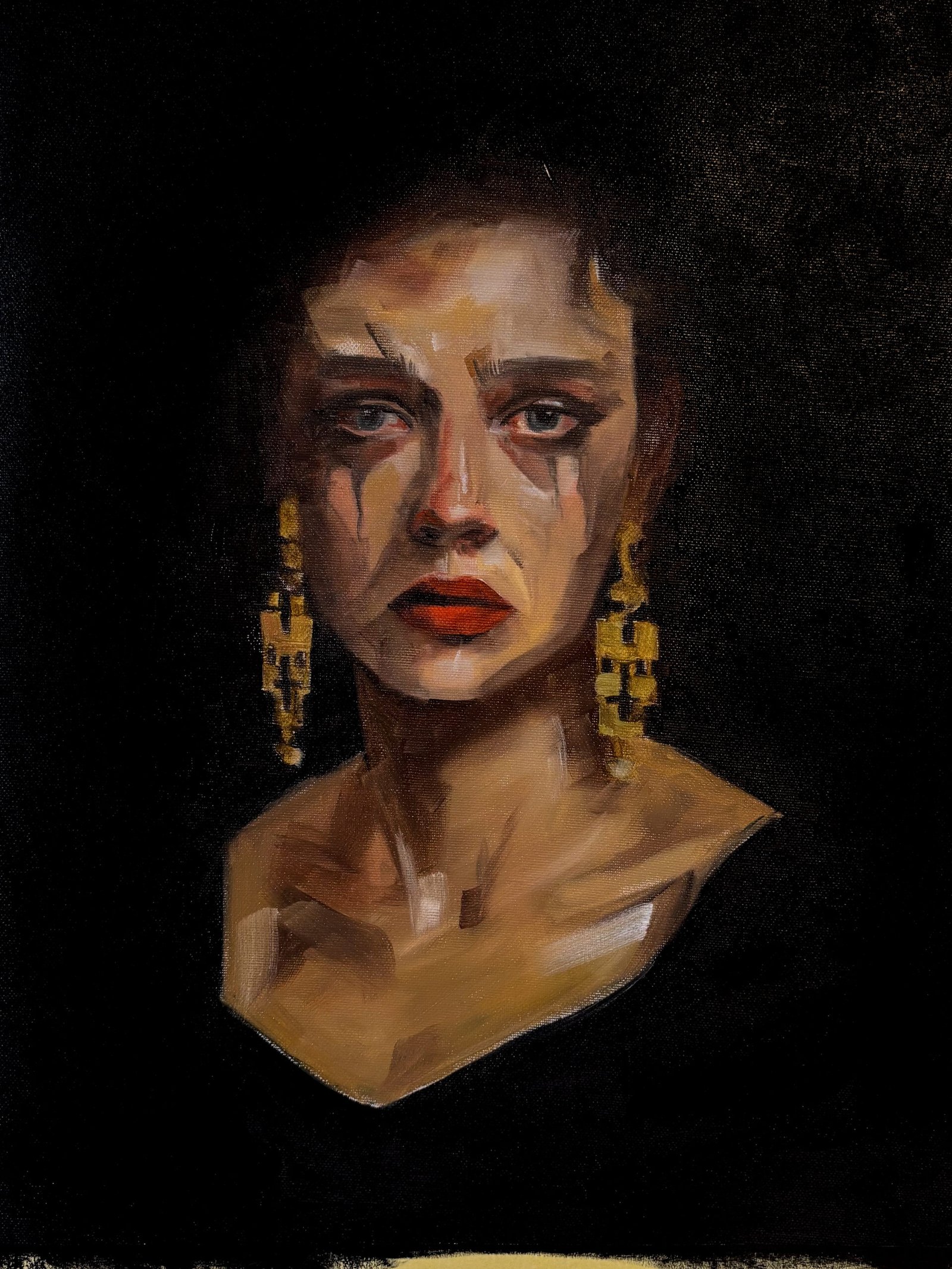
A year ago, I had a chance to have a conversation and present my work in one local British gallery. Between all the advice the owner gave me that day, one was itching me the most—paint in smaller formats. It wasn’t sitting with me because I thought that it’s easier to paint big, as you can be more imprecise, but also you can charge more money for bigger formats.
I didn’t take his advice seriously back then, and even worse, I bought more and bigger canvases than I used to. The result: I now sit on a pile of massive paintings that I stock in the “needs to be finished” pile and never tackle them any more because I get frustrated at how much work it will take to finish them at my perfectionism level.
Well, for a gallery it’s mostly a practical question: you can fit more of smaller artwork in the gallery. At least, that was what I thought at that moment his intention was. It took me time (and this whole offing pile of unfinished works) to realise that this piece of advice was specifically for me. I paint very detailed and realistic paintings. Which I promise isn’t my intent at the beginning of every artwork. I just keep going, trying to make it as detailed as possible, as I stare at it for hours and find the potential to make it even better as it was. Which brings me back to the same spots over and over, layering them with new details, using smaller brushes, mixing more nuanced colours.
For my art bing scrolling, I love to see how other artists just put three and a half thick uncoloured brush strokes on the canvas and it works. And every time I start a painting, I promise myself to follow that technique. And every single time I fail at it. It looks unfinished to me. I go to the reference and back to the canvas, seeing more and more details that I cannot help but paint.
I posted some of those extra detailed artworks last year, look them up. And as much as I love them, it’s unrealistic to make any living out of them if I continue to sit on every leaf for an hour for five layers straight. And of course for somebody who struggles with not only perfectionism but also procrastination, this path is the most unrealistic to follow.
This summer I started a series of portraits and for the first time I set up frames for myself. I focused on portraits and specific size, so the collection looks cohesive. For the first time I invested in a giant roll of canvases instead of buying done framed ones (which is actually cheaper, you just need to die once at the cashier desk), so I was able to cut the specific size I wanted them to be. After finishing four portraits, I realised one thing: I went through them so fast! I made a deal with myself that they’re not supposed to be perfect — done is enough!
This gave me so much freedom from my perfectionism. I think, the endless layering was a result of me learning by doing in the very process. It goes like: I learn some new technique while painting one spot in the painting, and then I’ll go over the whole painting to match the style. The funny part is that by doing that I would already up my skill and would go on the round two and three, and so on… But this time, as the goal was to just get the piece done, I was able to learn something and implement the new skill and the next new artwork.
Every time I see these works, I think of something that I would do differently or where I need to go over to put some finishing touches, but I resist. I resist ruminating on the same artworks for decades. I see how my skill grows by doing more of different instead of doing more of the same over and over again.
The message is: By doing more of imperfect, you’re able to move faster towards the perfect result. Just move on. Just do more. Do different. Learn new colours. Learn new compositions. Learn how different types work. Don’t be stuck in the overengineering what you already have. Analyse the skill you’ve just learned and implement it differently. Be the change.
My last series that I just started on portraits of characters from books, I went as small as 30 by 40 cm. I just finished painting Anna Karenina, and it took me just one hour to finish it. Is it perfect? No. Will my next artwork be better? Yes.
Every so often, you need to go smaller to achieve bigger things. Smaller steps are more steps to count and more opportunities to learn and improve. Maybe one day I’ll even return to sketching or digital drawing. But for a moment, I’m happy to be able to produce a portrait a day.
P.S. hit me up if you want me to paint you or anybody else you would like to have as a painting!
Love you,
Lorena